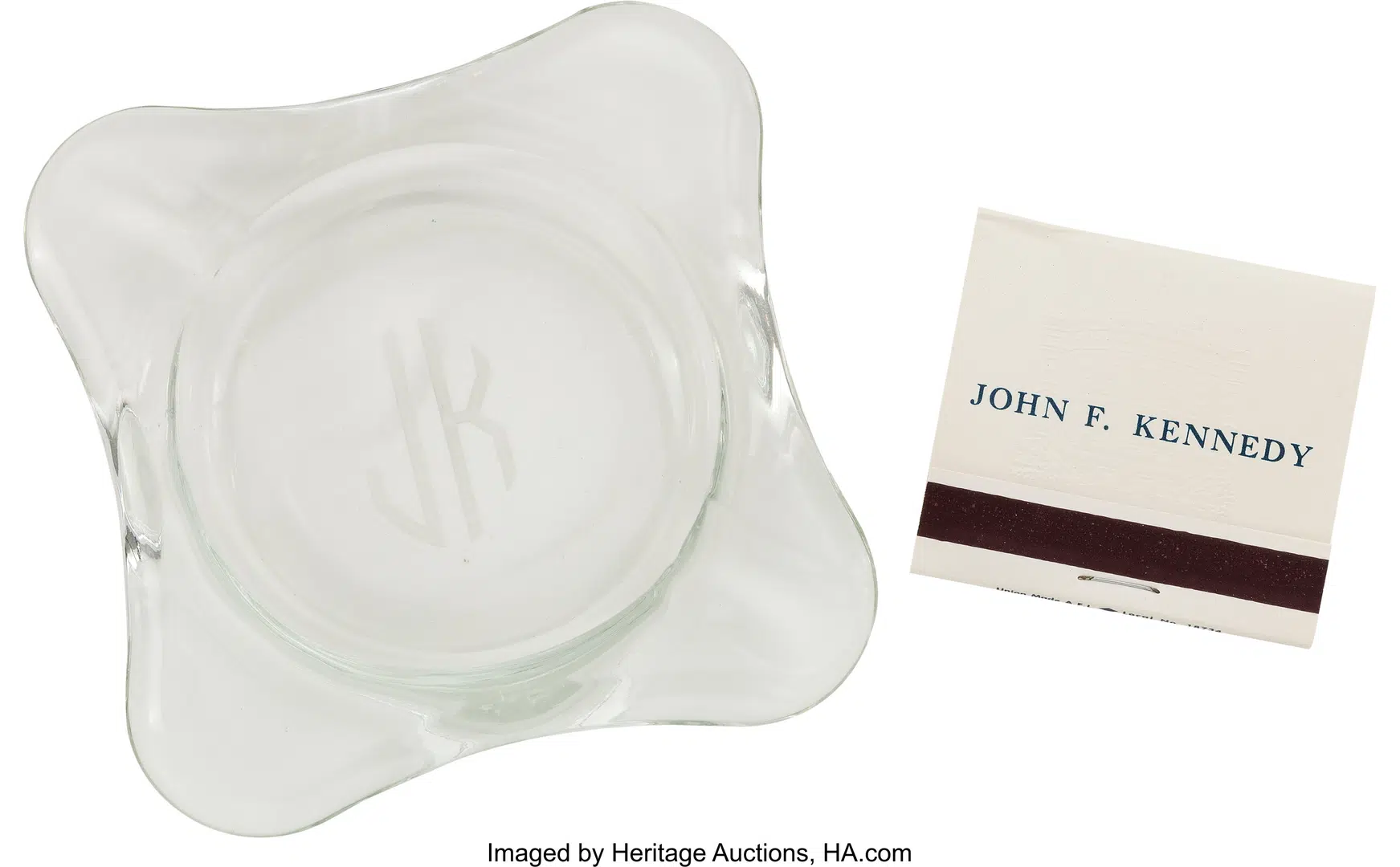
Imagine sitting down at a White House state dinner during the Kennedy years and discovering a matchbook waiting at your place. Not a tourist trinket or souvenir, but an official White House matchbook, curated and positioned with intention for each guest. Minute, refined, and powerful, it embodied the effortless sophistication of the Kennedy era.
John F. Kennedy’s brief presidency from 1961 to 1963 was style personified. State dinners surpassed diplomacy; they were meticulously choreographed showcases of culture, art, and refinement. Artists, writers, diplomats, and world leaders gathered around perfectly arranged tables while Jacqueline Kennedy Onassis directed every detail with her signature grace. Amid fine china, sparkling crystal, and polished silver, the modest matchbook subtly echoed the administration’s devotion to aesthetics.
The official White House matchbooks were elegant and restrained. Off white in tone, they featured Kennedy’s name printed in Democrat blue on the front and the Seal of the President of the United States on the reverse. An embossed rendering of the White House pressed into the cover added a tactile dimension. Measuring approximately 1.9 by 2.1 inches, these compact objects conveyed authority without excess. Positioned at each setting during state dinners, they became part of the sensory experience, a finishing touch in evenings designed with precision.
Beyond the ceremonial editions, there existed an even more private cache, a collection of white matchbooks associated with Kennedy’s personal use inside the residence. Each measured roughly two inches square and carried a silver “JFK” monogram on the cover — minimal, polished, distinctly his own.
Their preservation is attributed to Mary Barelli Gallagher, a stenographer who served as Jacqueline Kennedy's secretary from 1957 to 1964. Gallagher safeguarded numerous pieces of memorabilia across decades of service. In the chaotic days following JFK's assassination in November 1963, she gathered and protected belongings during the rapid clearing of the residence, ensuring that these small yet historically resonant pieces endured. Without her vigilance, this rare window into the Kennedy White House might have disappeared.
The silver monogrammed version offers an intimate look into Kennedy’s private life and presidency. Kennedy’s smoking habits were discreet. He occasionally enjoyed cigarettes and Cuban cigars, though photographers seldom documented the ritual. In the early years of their marriage, Jackie reportedly encouraged the habit, partly to normalize her own three pack a day routine, a detail the press never publicized. Within this cultural context, the matchbook transcends utility. It reflects a mid century moment when cigarettes, cigars, and their paraphernalia signified status and identity as much as indulgence. One can easily imagine it resting on the Resolute desk beside briefing papers during a late night strategy session.
Kennedy’s connection to matchbooks also extended beyond the Oval Office. During the 1960 presidential race, campaign editions functioned as portable political messaging, tucked into pockets, left on bar counters, and circulated at social gatherings across the country.
His image also traveled in a different, unexpected way through the world of philately — the study and collection of postage stamps and postal history. In the years after his assassination, companies recognized the enduring power of the Kennedy profile. The Kenmore Stamp Company produced promotional matchbooks featuring a Kennedy commemorative stamp, often an international issue honoring him after 1963. By pairing a collectible stamp with a matchbook cover, Kenmore cleverly bridged two hobbies, philately and phillumeny. The design transformed the matchbook into both advertisement and memorial, allowing collectors to hold a miniature tribute to Camelot in the palm of their hand. It was marketing, certainly, but it was also evidence of how deeply Kennedy’s image had entered global popular culture.
Then there was the sky. Aboard Air Force One, matchbooks accompanied the President as well. Early presidential aircraft in the Kennedy era carried versions bearing the Air Force One insignia, blending aviation iconography with executive symbolism in pocket size form. Whether stocked for staff, presented to guests, or included within the aircraft’s formal service, the Air Force One edition transformed an everyday object into a symbol of power, movement, and modernity. Camelot cruising at 30,000 feet.
Today, JFK era matchbooks, from campaign issues to state dinner examples, personal monogrammed pieces, and the elusive Air Force One versions, appear in online auctions as coveted pieces of JFK ephemera. They surface alongside signed photographs, inaugural invitations, and other remnants of Camelot, catalogued as presidential memorabilia and pursued by collectors worldwide. What once rested quietly at a place setting now enters digital bidding wars, shifting from dinner detail to investment worthy artifact.
For collectors, they represent the ultimate intersection of history and aesthetic discipline. Evidence that the smallest objects can carry the greatest narratives, traveling from velvet roped state dinners to the cabin of Air Force One and ultimately to the auction block.